SAP-GIS Integration
Smallworld Business Integrator (SBI)
The Smallworld Business Integrator (SBI) is a standards-based technology for integrating SAP and the Smallworld GIS. The add-on product SBI Monitor ensures fast and transparent implementation of this technology:
- Supports direct bidirectional integration
- Supports service-oriented architectures (SOA)
- Phased implementation concept
- Globally deployed standard productSupports
Integration of Smallworld GIS into the company’s IT infrastructure
The integration of key systems such as ERP and GIS plays a crucial role in optimizing business processes. As the manufacturer’s standard product, SBI does exactly that: It creates a company-wide database that can be used holistically and offers the highest level of security thanks to its numerous existing installations.
Flexible Integration platform
In conjunction with the SBI Monitor, SBI enables Smallworld GIS to be integrated with the rest of the company’s IT infrastructure using standards-based communication. This supports both direct integration with SAP S/4HANA or SAP R/3 via the Java Connector (JCo), and indirect integration via middleware platforms.
A PRACTICAL PHASED APPROACH
Thanks to its modular design, integration can be expanded in stages. A cost-effective and high-performance entry point is possible, for example, through a data-oriented direct integration of the systems. This approach is particularly recommended for the initial data loading and initial integration, which typically involve large volumes of data. The solution can later be easily expanded into a service-oriented architecture (SOA) that integrates flexibly into a company’s IT landscape.
Components of SBI
Business objects serve to bridge the gap between different data models. To this end, they form an abstraction layer between the actual objects and the interface. This allows an easy-to-maintain 1:1 mapping to be established for object structures that are represented differently.
For example, an SAP property connection, which corresponds to several technical objects on the GIS side (such as a connection object, pipe section and shut-off device), can be mapped to an aggregation of these objects. This hides the breakdown of the property connection that is irrelevant for the integration and enables a 1:1 mapping between SAP and GIS. Queries for individual attributes of the GIS house connection are transparently distributed by the system to the subordinate real GIS objects. This can be used, for example, in evaluations initiated from SAP.
An aggregated business object usually has a main object from the underlying database, ensuring uniqueness and easy reconstruction from the database.
This is essential to ensure that large-scale planning and construction projects can be documented alongside smaller, routine changes to the network. The changes can then be merged back into the master (the so-called main alternative) in any order, in a coordinated manner. Robust conflict management ensures that no data is lost when merging the concurrent changes into the main alternative.
The mapping engine allows you to define the mapping of business objects for two linked systems. In addition to the basic mapping of classes, you can also configure the keys used and the field mappings. The field names may differ, and it is possible, amongst other things, to map value catalogues.
The synchronisation engine is used to automatically transfer changes to objects from one system to the other, provided that these objects are maintained redundantly in both systems. The synchronisation engine utilises the mapping engine both to identify the appropriate target object for a modified source object and to translate field changes in the source system into corresponding field changes in the target system.
Naturally, the insertion and deletion of objects are also taken into account. In this context, it may be appropriate to ignore deletions in the source system in the target system and simply remove the link to the target object, or to translate a deletion in the source system into a change to a status field in the target object (e.g. status ‘decommissioned’).
The Consistency Checker allows you to check the linked business objects and attributes for consistency at any time or, if necessary, restore them.
Valuable support for your integration projects with SBI
SBI Monitor
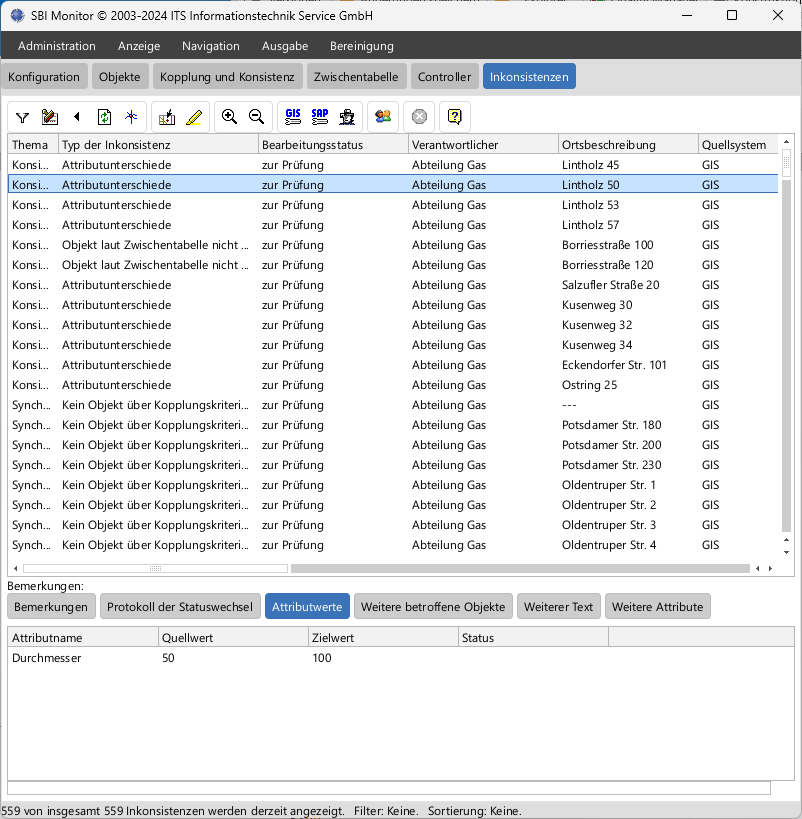
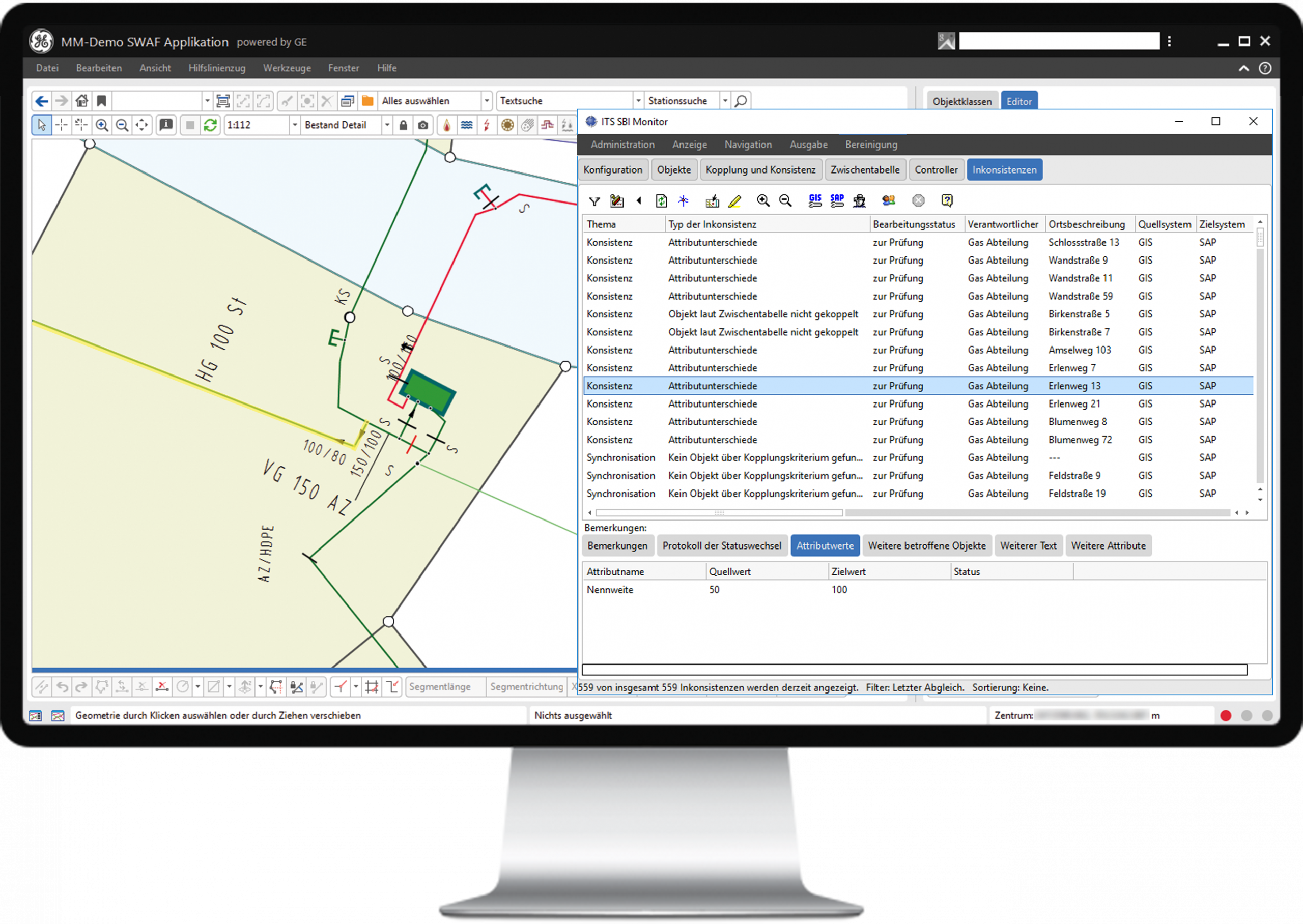
With the SBI Monitor, the Smallworld Alliance offers a supplementary product to the SBI, providing a user-friendly interface that makes the linking and synchronisation of objects easily accessible to definable user groups.