Smallworld GIS
Geo Network Management (GNM) – the foundation for professional network operation
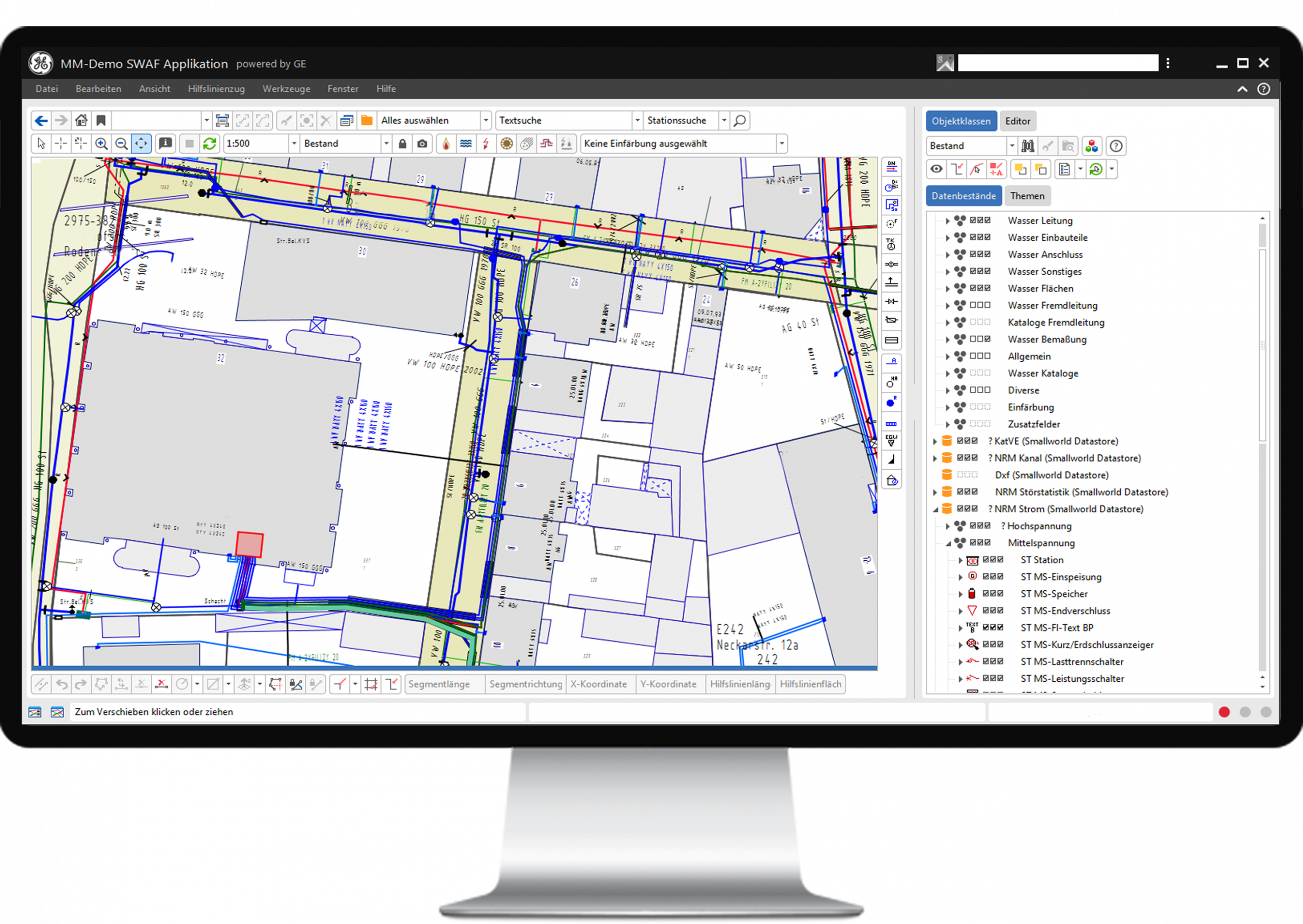
With Smallworld GIS, you can create and manage a detailed digital representation of your entire network infrastructure in the utilities and telecommunications sectors – both spatially and schematically.
Smallworld GNM is more than just a modern system for network documentation and GIS information. It is genuine spatial management for an increasingly dynamic network development – Geospatial Network Management.
For network operators, Smallworld is the ideal and tried-and-tested platform for utilising spatial information across the entire organisation. This enables you to optimally support the processes involved in the expansion, maintenance and renewal of your infrastructure.
Why do most network operators choose Smallworld?
The Smallworld GIS (GNM – Geo Network Management) is based on state-of-the-art standards and was developed specifically to meet the requirements for mapping networks. Since its inception in the 1990s, it has been a leader in the field of GIS systems for network operators thanks to its exceptional scalability, functionality and data quality. Satisfied customers worldwide attest to the system’s performance. It is therefore the leading GIS in the industry, not only in German-speaking countries.
A pioneer in GIS technology
Smallworld’s version management system enables a large number of users to collaborate and make changes simultaneously to complex spatial network models, such as those found in the utilities and telecommunications sectors. This feature remains one of the cornerstones of Smallworld solutions, enabling multi-user operation during data capture and network modifications without the need to lock sections of the network.
This is of fundamental importance so that large-scale planning and construction projects can be documented simultaneously with smaller, routine changes to the network. The changes can then be coordinated and merged back into the master (the so-called main alternative) in any order. Robust conflict management ensures that no data is lost when merging the simultaneous changes into the main alternative.
By utilising the latest Java platform, Smallworld has been meeting the requirements of modern system architecture and high security standards for several years now. Java complements the proprietary, object-oriented programming language Magik. Thanks to its flexibility, Magik has been a decisive factor in the system’s widespread adoption and success from the very beginning. The option to use Java means that hybrid Java-Magik applications can be implemented quickly and cost-effectively, even without Magik expertise. Examples of this include simplifying integration tasks or improving system performance.
Version 6.0 of Smallworld GNM paves the way for data storage based on proven industry standards through the optional use of a PostgreSQL database in place of the previously used VMDS (Version Managed Datastore) database technology. Combined with the proven version management for multi-user access, this provides Smallworld GNM with the prerequisites for even more efficient operation of the GIS in a cloud environment. Cloud capability is a central component of a modern and secure system architecture and a cornerstone of the GE GridOS strategy.
The third dimension is becoming increasingly important for assets in GIS, as many planning and documentation tasks now require a precise spatial understanding. By incorporating elevation data for assets and terrain data from a digital elevation model (DEM), collisions can be reliably assessed at an early stage of planning, and cross-sections can be generated directly from the GIS for detailed network planning.
The survey data can be imported into the GIS using the 3D importer and processed further there. Interactive visualisation via the 3D network model in Smallworld GIS makes it possible to display assets from different utility sectors in their actual spatial location within the context of the terrain and buildings. Furthermore, the export of 3D models facilitates collaboration on construction projects, particularly when these are implemented using BIM methodology.
Smallworld GIS offers genuine future-proofing: thanks to its exceptional scalability, the system adapts seamlessly – from small municipal utilities to large-scale network operators with millions of assets. Sophisticated sector data models and a consistent node-edge model ensure that even the most complex networks are always represented topologically correctly and reliably.
Whether in service areas with 30,000 or 3.5 million inhabitants: installations of any size can be implemented without difficulty. The high flexibility and performance of Smallworld are also evident in day-to-day use – hundreds of thousands of changes per year are processed efficiently, whilst any number of users can work simultaneously in a single database.
Smallworld GIS: The perfect platform for efficient, powerful and future-proof geodata management.
RAPID IMPLEMENTATION PROJECTS
Thanks to its key ability to rapidly establish a fully functional, robust and network-wide productive solution in implementation projects, Smallworld GIS has built up an extensive customer base in the utilities and telecommunications sectors. A large number of successfully completed Smallworld implementations for customers of all sizes and with varying starting points, combined with an established and proven project implementation process, form the basis for a rapid go-live. Direct and continuous communication between the project team and the customer, alongside iterative migration tests and early user training, is a key factor in ensuring success.
Another key factor for a successful GIS implementation is the distribution of data both within and outside the organisation. Whilst a small number of experts utilise the full range of GIS functions for asset documentation, web solutions and mobile apps make the GIS data available to a large number of end users. Established interfaces with other enterprise systems extend the benefits of GIS and spatial information deep into the company’s processes, for example in ERP systems, network calculation, work management, asset management, control systems or CRM systems.
Data and process models for all utilities
Smallworld offers sophisticated and well-developed data and functional models to meet the requirements of all utility and waste management sectors, as well as for the management of the base map: the Smallworld sector-specific modules (NRM) for utilities and waste management, and Smallworld PNI for telecommunications. As a developer, the Smallworld Alliance brings extensive expertise to the industry modules and, as part of product development, continuously expands their functional scope in line with current market developments, regulatory requirements and industry standards, as well as the needs of the Smallworld User Group (SWUG), which has over 150 members.
The resulting industry-specific module releases are published regularly and in coordination with the development of the Smallworld GNM base. This continuous development ensures that, alongside many other topics, changes required by global trends such as the energy transition are quickly made available to users within the product standard.
Integration capability
Thanks to its openness, the Smallworld system plays a key role in optimising business processes. The integration of the GIS with key technical and commercial systems is crucial in this regard.
As a standard product for ERP integration, the Smallworld Business Integrator (SBI), for example, creates an enterprise-wide database that can be utilised holistically. It supports both direct connections to SAP via the Java Connector (JCo) and indirect connections via middleware platforms.
A wide range of interfaces to network calculation programmes, network control technology and operational management systems also ensure a smooth flow of data, thereby enabling the profitable use of GIS data at key points within the organisation.
CLOUD-READINESS
For companies pursuing a cloud-focused strategy, the Smallworld Alliance offers turnkey solutions for the transition phase and the migration of the Smallworld system to the cloud. The major advantages of the Smallworld architecture – such as scalability, performance and standard data models, which other systems offer only to a limited extent – thus also open up new possibilities for integration.
In addition to the security aspects of cloud operations, the question of resources is also becoming an increasingly important factor when deciding on a cloud-based GIS. Here too, a range of options is available, from simply migrating the system to the cloud, through GIS administration, to a Software-as-a-Service model including network data maintenance. The Smallworld Alliance offers you suitable solutions and will be happy to advise you.
.
Setting off into the future with Smallworld
The demands placed on GIS systems are growing in line with the increasing digitalisation not only of networks but also of a network operator’s processes. Smallworld GNM, with its specialist modules, is ideally equipped to meet both current and future requirements and, thanks to a large number of well-connected users, always keeps pace with the latest developments. The Smallworld portfolio offers a wide range of proven solutions for areas such as 3D network visualisation, the use of augmented reality in surveying, and the simple, real-time integration of network data into peripheral systems such as network control technology and smart grid platforms.
In the international arena, Smallworld is already integrated into the GridOS platform from system manufacturer GE Vernova. This open, end-to-end system for utilities runs as a native cloud solution in a Kubernetes environment and meets the requirements of zero-trust security. The Smallworld data models, containing the captured network data, provide the foundation for numerous microservices designed to precisely support the business processes of network operators.
Working together for a strong Smallworld GIS
The companies in the Smallworld Alliance are long-standing service and development partners of GE Vernova in the field of Smallworld software. We foster close and trusting collaboration between the manufacturer and users, and ensure investment security for our customers.