
Smallworld NRM
NRM District Heating
The District Heating module forms the basis for the documentation and analysis of district heating networks. A comprehensive data model enables a realistic representation of the infrastructure from the producer to the consumer at various levels of detail.
In addition, the module supports the documentation of smaller installations within the network as well as detailed views of the internal structure of buildings.
Various expandable media can be recorded in the module. The basic configuration includes hot water, steam and chilled water.

Network Logic and Data Model
The data model was developed in accordance with the specifications provided by the business users, with the aim of creating a representation that accurately reflects the real world. The names of the object classes correspond to the names of the assets installed in district heating networks. Each GIS object describes a piece of equipment and manages the geometric and attribute data within the object. This allows statistics on the equipment in the network to be derived, and the unique object reference enables optimal support for interfaces with ERP and network calculation applications. The equipment is classified into the following groups:
- Networks/Generators
- Routes
- Pipelines
- Fittings
- Monitoring
- Plants
- Consumers
A fully developed Process model for your district heating network data
NRM District Heating provides you with a wide range of tools for the efficient management of the network, such as a wizard for recording house connections, as well as a variety of dimensioning functions and output options.
The analysis functions are equally well thought out, such as those for determining the supply route, identifying unsupplied connections, or colour-coding different materials.
The District Heating module integrates seamlessly into a multi-utility environment alongside the other standard Smallworld modules.
Pipework documentation
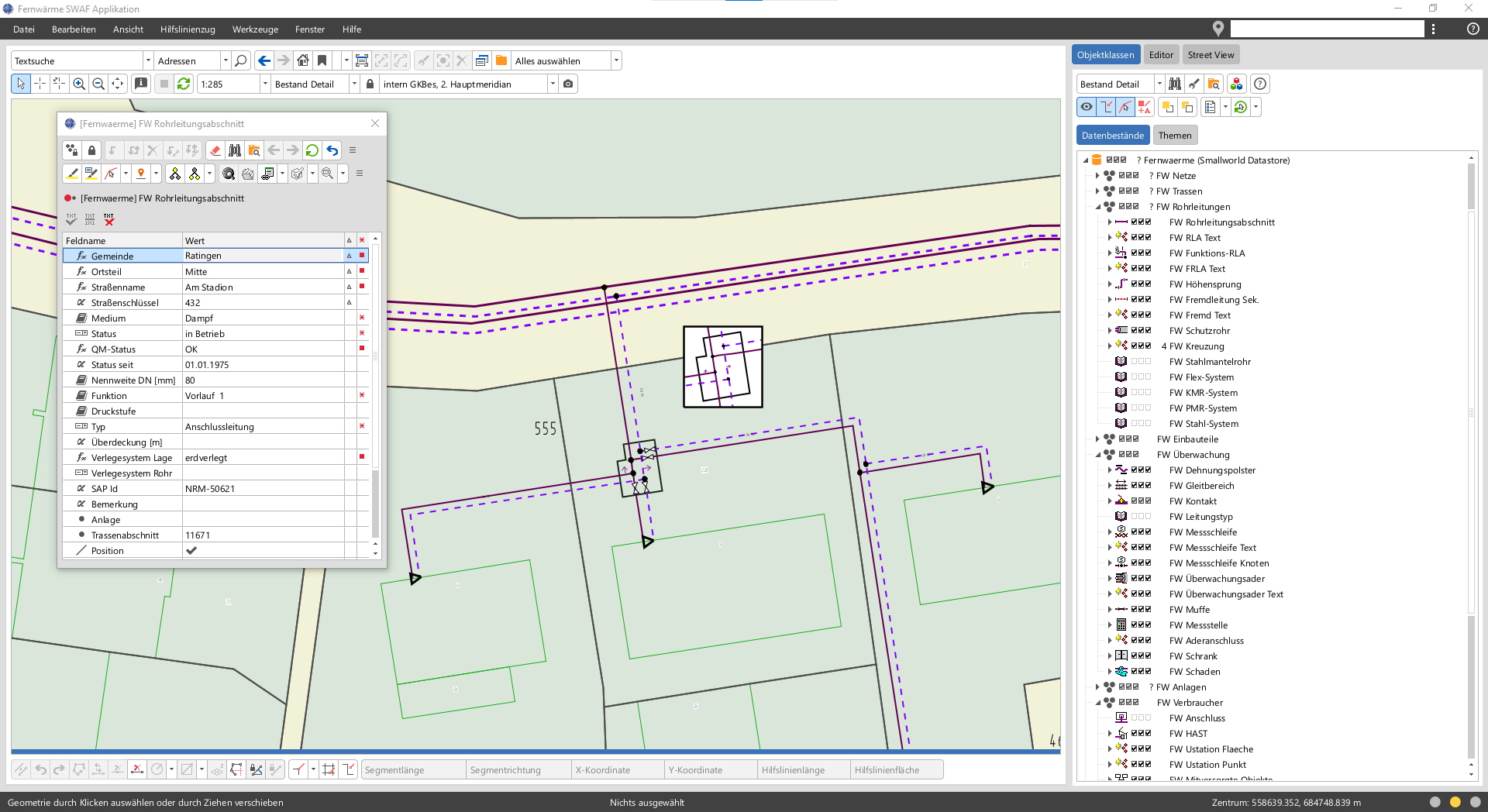
The focus of the network documentation is the recording of pipe networks. These consist of pipe sections and fittings. The main distinguishing feature of pipe sections is their function. In the basic configuration, typical functions such as supply, return and condensate can be recorded. Special functional pipe sections, e.g. for drainage, venting and circulation, expand the capabilities of the pipe network documentation.
The geometric position of the pipelines can usually be generated from the position of the associated route. To this end, standard cross-sections are assigned to the route sections, in which the function, nominal diameter, horizontal distance from the route and height difference to the route of each pipeline section (component) are recorded.
Based on this information, the corresponding pipe sections are automatically generated for selected route sections. Even for route sections that do not run in a straight line, the position is calculated correctly according to the standard cross-sections entered. In addition to automated design, pipeline sections can also be entered or modified manually if, for example, the position of a pipeline section or node area cannot be adequately described by the data entered in a standard cross-section. In principle, the pipelines do not have to lie horizontally next to one another, but can also be represented vertically.
Route documentation
A key feature of the District Heating module is the documentation of the contents of the overview plan in the form of a route diagram. The overview plan, e.g. at a scale of 1:2500, is a generalised representation of the as-built plan. Typically, when recording pipe networks, the process begins with the documentation of the route, from which the pipe sections are automatically derived as a multi-line representation of the pipe networks. This derived position of the pipelines forms the pipeline network documentation in the as-built plan, e.g. at a scale of 1:500. This procedure requires the route position to be surveyed. Alternatively, the route documentation can be omitted and the pipeline network documented purely on the basis of the surveyed pipeline routes.
Additional features of the district heating module
- Documentation of structures and network stations
- Pipeline network monitoring
- Details of producers and consumers
- Network tracking
- Cross-section
- Longitudinal section